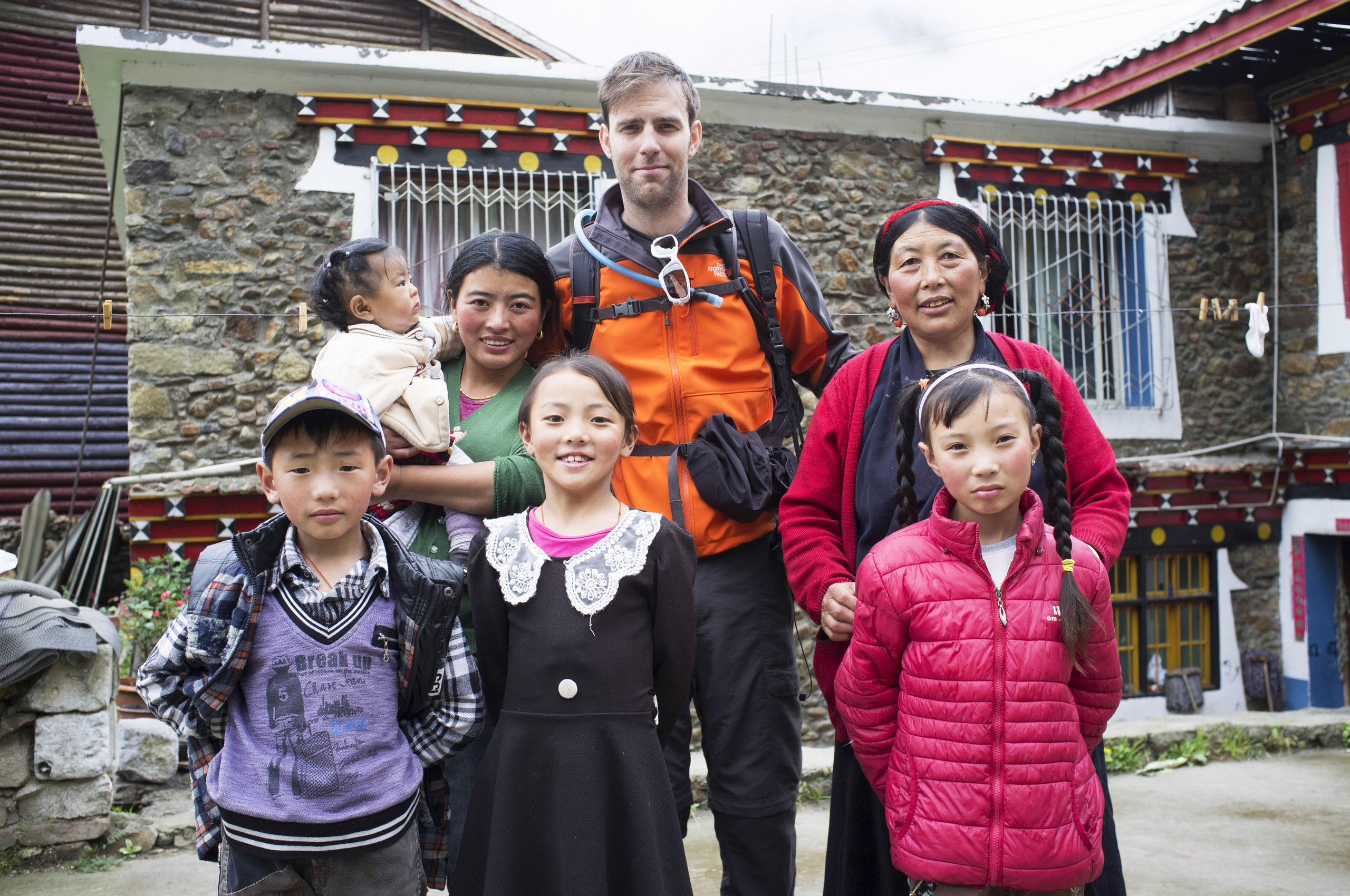
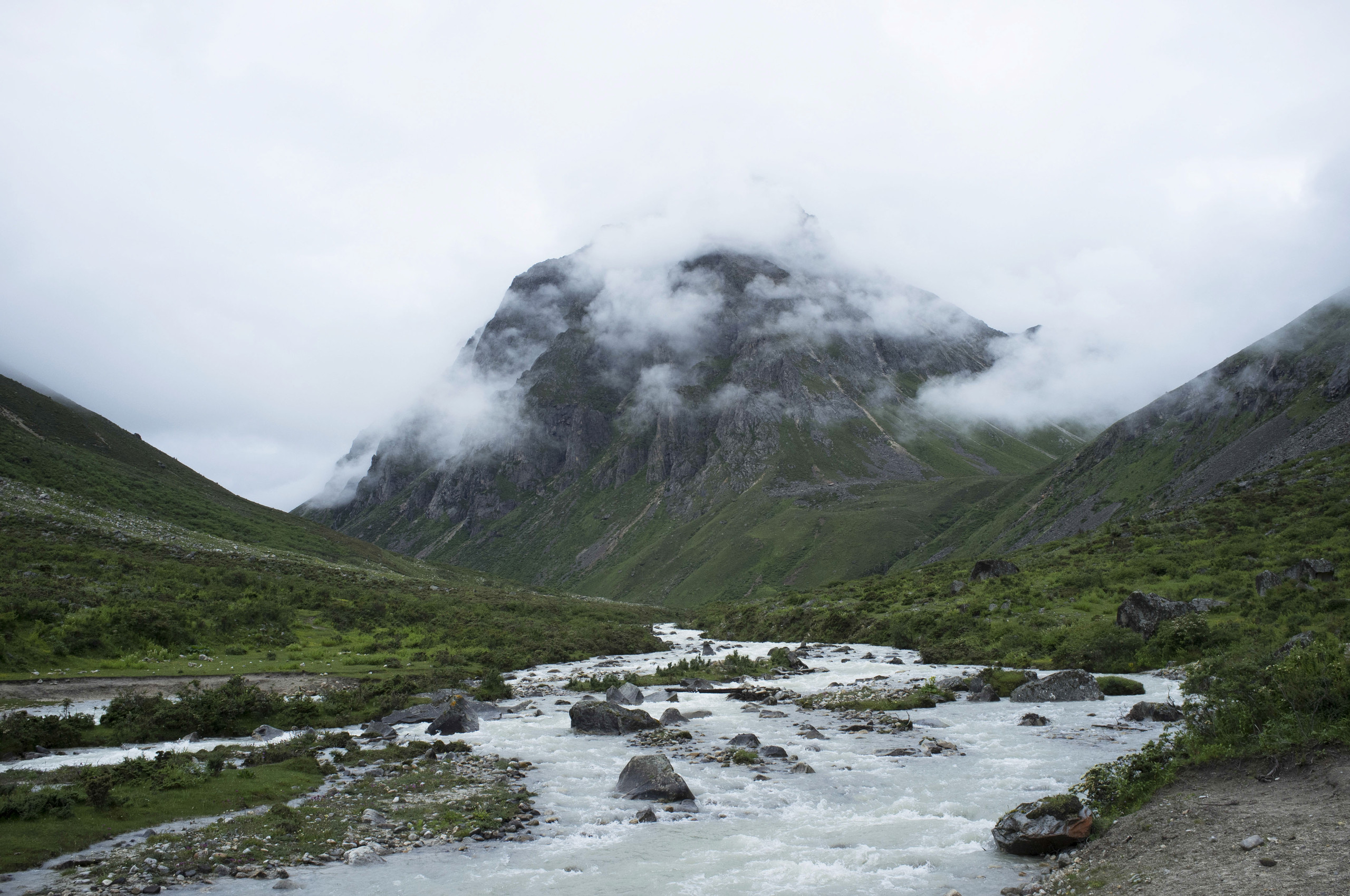
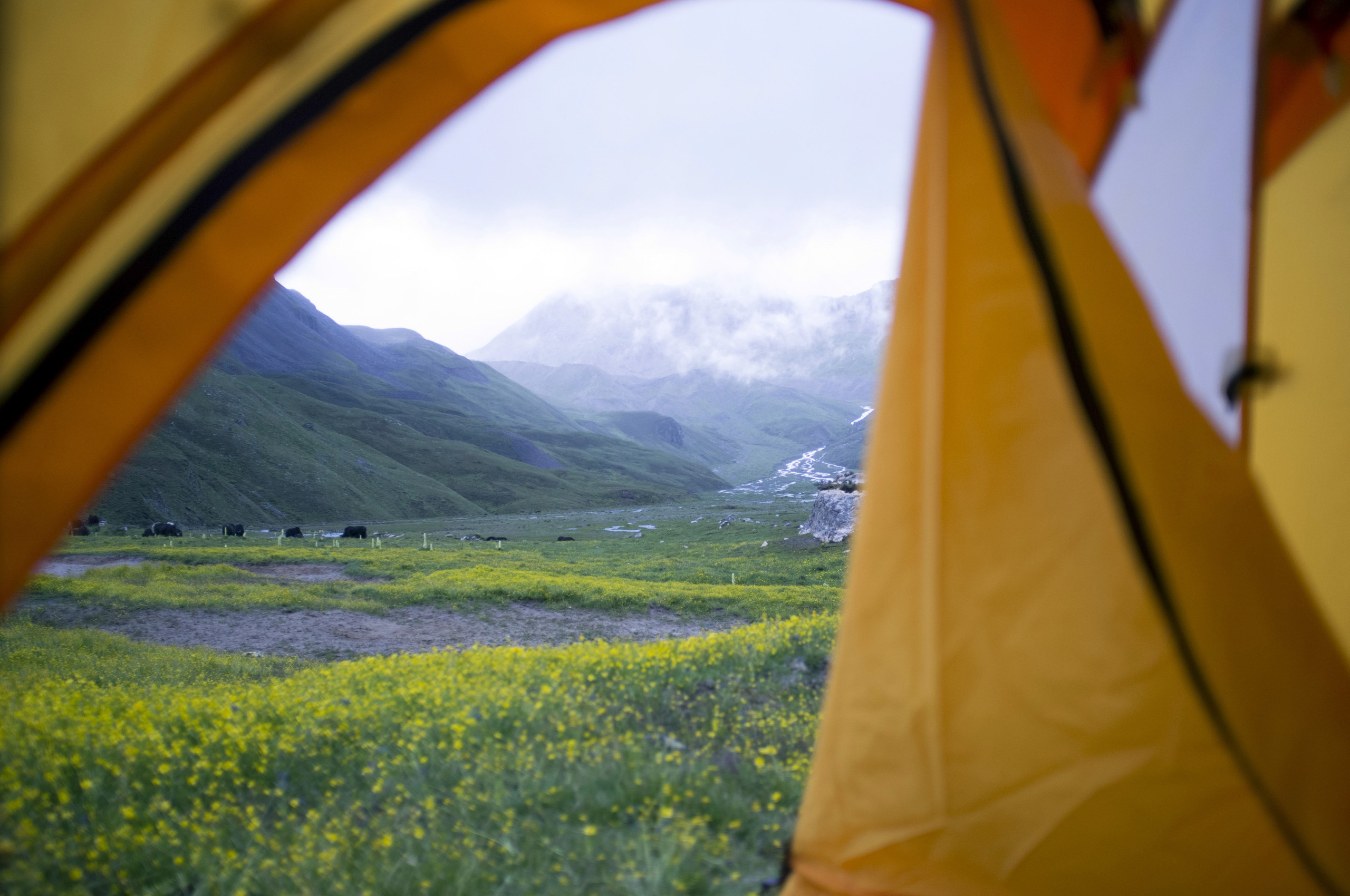
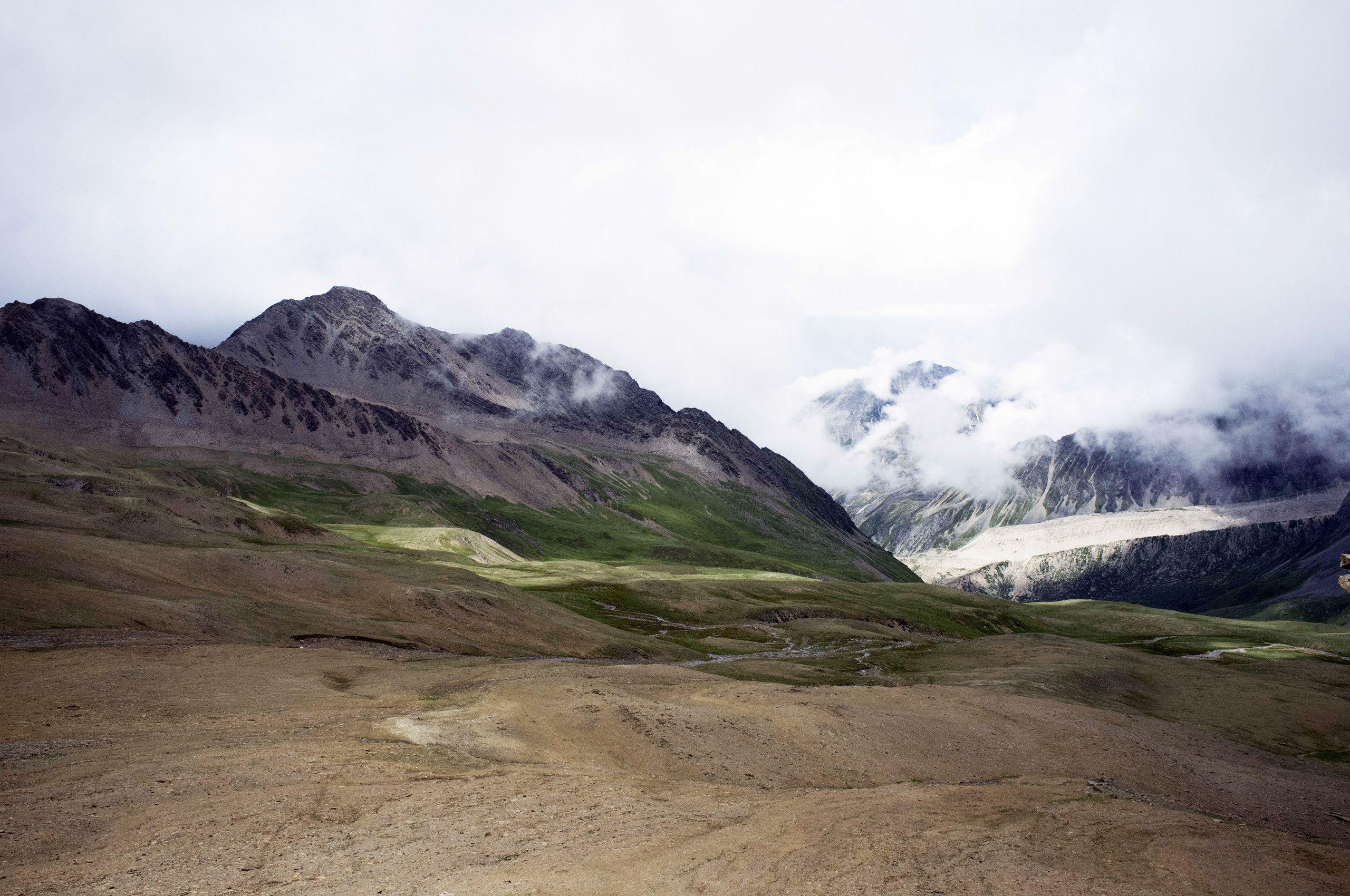
01Minya Konka. I have my picture taken with Jangbu’s family outside his guest-house in Laoyulin, where we stayed before setting out on our trek.02Minya Konka. Following the river south from Laoyulin up into the mountains.03Minya Konka. Yaks graze amongst the yellow flowers that cover the grassland outside my tent in the early-morning sunshine.04Minya Konka. The green grasslands give way to brown dust as we reach the high plateau of southern Sichuan Province.05Minya Konka. A male yak with large horns attacked one of our donkeys, leaving it with a severe leg wound, just one example of the many risks of trekking on the high plateau.06Minya Konka. As we follow the Moxi River down the lush, fertile Moxi Valley, we are just a few days away from our first sighting of the sacred mountain.07Minya Konka. Another camp site amongst the flowers, this time in the late afternoon in the Moxi Valley.08Minya Konka. In the distance, beyond the red rooftops of the Gongga Monastery, is the snow-streaked peak of Minya Konka.09Minya Konka. The sacred mountain is framed by prayer flags in the grounds of the Gongga Monastery.10Amne Machin. Dark clouds gather above the gates that mark the start of the trek near the village of Xiadawu.11Amne Machin. Brilliant blue sky throws the topography into sharp relief on the high grassland plateau that makes up much of southern Qinghai Province.12Amne Machin. A triangular patch of red prayer flags resembles a field of poppies on a slope above a monastery on the outskirts of the village of Xiadawu.13Amne Machin. Under a cloudless sky, two pilgrims do prostrations in the early stages of a journey around the mountain that will take them several weeks to complete.14Amne Machin. Grass has given way to barren, friable dirt and snow-covered rocks as we approach the first high pass of our trek around the mountain.15Amne Machin. The yaks below me in the distance are drinking from what remains of the river on the remote southwestern edge of the mountain.16Amne Machin. The snow-capped peak of the sacred mountain is reflected in the icy water of a small glacial pond.17Amne Machin. We set our camp just in time before dark clouds rolled in to cover the mountains that surrounded us.18Mount Kailash. Potala Palace, on the western edge of the city of Lhasa, is now a museum and World Heritage Site.19Mount Kailash. Looking out from the Drepung Monastery towards western Lhasa and the mountains beyond.20Mount Kailash. An elderly pilgrim spins a prayer wheel as she performs a kora around the Jokhang Monastery on Barkhor Square in central Lhasa.21Mount Kailash. Lake Manasarovar, seen here from the Chiu Monastery, is a large freshwater lake south of Mount Kailash and some 15,060 ft (4590 m) above sea level.22Mount Kailash. A bleak campsite on the high-plateau grasslands near the village of Darchen where we stayed prior to setting out on our trek around the most sacred of all the mountains.23Mount Kailash. Our first view of the distant, snow-covered, dome-shaped peak of the sacred mountain. Where else would the gods choose to live?24Mount Kailash. A plethora of prayer flags are suspended from poles and strewn across the rocks at the start of the trek. Mount Kailash is the snow-capped peak on the left in this photograph.25Mount Kailash. Ice-cold water cascades from the waterfall on the left into one of the many rivers that flow through the valleys surrounding the mountain.26Mount Kailash. The sunlit snow on the west face of the mountain peak contrasts sharply with the dark, jagged rocks beneath it.27Mount Kailash. The only place to camp on this occasion is on rough, stone-covered ground under the north face of the mountain.28Mount Kailash. Packing up camp is a dismal process in the bitter cold of the early morning on what turns out to be the toughest day of the trek as we ascend to the Shula Pass.29Mount Kailash. The clouds roll in and the snow starts to fall as we begin the ascent to the Shula Pass.30Mount Kailash. On the way up to the Shula Pass, the midway point of the trek is marked by a heavy snowstorm.31Mount Kailash. More storm clouds cover the mountains as we descend on the other side of the Shula Pass.32Mount Kailash. Pilgrims make their way along the trail around the eastern side of the sacred mountain.33Kawa Karpo. Corn has been hung out to dry on the balcony of one of the old wooden houses in the village of Yongtsa, where we began our trek around the mountain.34Kawa Karpo. Our guide and translator, Dorgee, and I stop for a drink at one of the small shops along the route on the first day of the fourth, and last, mountain trek.35Kawa Karpo. Incredible mountain scenery surrounds our camp on high- altitude grassland in the last valley before the high pass.36Kawa Karpo. Pilgrims who have stayed overnight in a teahouse on their kora around the sacred mountain huddle close to the stove where water is being boiled for yak-butter tea.37Kawa Karpo. There are small shops like this one at intervals along the route selling high-carb drinks, sweets, alcohol, and other ‘essential’ provisions to fortify weary pilgrims and other travelers.38Kawa Karpo. Prayer flags mark the start of the Duoke La Pass, on the border between the province of Tibet and the province of Yunnan.39Kawa Karpo. Looking back down the trail after a grueling ascent to the Duoke La Pass at 16,076 ft (4900 m) above sea level.40Kawa Karpo. In the later stages of our trek, we encountered some young Tibetan boys ducking and weaving their way on motorcycles through strands of prayer flags on an impossibly narrow path at the very edge of the mountain.41Kawa Karpo. On the other side of the high pass, the trail continues, descending now towards the Nujiang River in Tibet.42Kawa Karpo. Towards the end of the trek, the landscape changed again and we entered a remote region of dust-brown mountains and glacial blue rivers, with the occasional small group of houses above cultivated terraces.43Kawa Karpo. Corn and other recently harvested crops are laid out to dry on the rooftops of homes in Kelbu village.44Kawa Karpo. Two young inhabitants of Kelbu village stop to have their photo graph taken.45Kawa Karpo. Preparing to leave the guesthouse in Kelbu village before setting off for the Shula Pass, which would be the last pass on the last of my four treks.46Kawa Karpo. An example of what most dinners are like up on the Tibetan Plateau while trekking. A small bowl of cabbage, potato and rice.47Kawa Karpo. Just making it to the top of the Shu La Pass was a victory in itself. It marked the end of an incredibly challenging day.48Kawa Karpo. A final photograph taken with the ever-cheerful Dorgee (far left) and the guides who helped me to complete my fourth and final trek around some of the sacred mountains of China.